
Weaving Justice and Love
Have you ever gotten into a mini war with a sibling or friend over who could get the last cookie? Well if you ever lost this argument, chances are you insisted with “That’s not fair!” and that “They’re so mean!”, and maybe even argued,“You don’t love me!”.
In this moment, you were hoping for some fairness, consideration, and maybe even half of the cookie. But this brings up the question𑁋who decides what’s fair? And if your feelings aren’t considered, where is the justice in that? This cookie argument is an unserious version of how people experience unfairness in society. As a community, we can often see this injustice in societal situations as well.
The idea of justice often brings up the principles of ethics and morals. Like feminist philosopher bell hooks explained, justice not just as punishment, but as liberation that dismantles the culture of domination (Monahan, 2011). When we think of justice, our minds jump to examples like, civil rights, fair punishment, and giving a voice to people of oppressed groups. On the other hand, love often gets confused as an internal, wild force that drives us to make impulsive choices. But love can be more than just a feeling, as defined by hooks, love is an active, revolutionary choice of care, commitment and a sense of justice towards yourself and others (Washington, 2024).
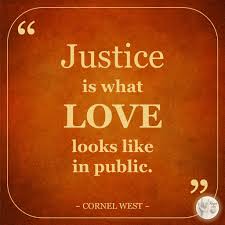
“Justice is what love looks like in public”, a popular quote by American philosopher Cornel West, helps us explore how love and justice coexist. Love brings care, emotion, and empathy while justice brings in respect, equity, and intersectionality. Together, they build an interwoven foundation for a just and loving society. Likewise, the “ethic of love" is a recurrent term in this research, and it is about serving others and yourself through trust, care, and consideration. The opposite is the “ethic of domination”, a system of abuse, greed, and power focused on allowing social oppression (Godden, 2017).
In a society of uncertainty, we begin questioning the immoral treatment that marginalized groups face by society, asking ourselves “Are these people treated fairly?” and “Why does this group have fewer rights than another?”. The most common answer is lovelessness in our system that results in violence towards indigenous people, genocide of oppressed groups, patriarchal imperialism, and a system of racism-sexism-classism (Giannacopoulos, 2020).
But what does this mean for our societal relationships? These inequalities we see in society are not just political issues, but a long term system that has faced a lack of love. For example, in criminology and decolonization practices, the hate towards indigenous people begins from the assumption that indigenous people should follow European values, like patriarchal imperialism, slavery, and control. The legal and societal system is more focused on penalty rather than ending oppression through recognition and love (Giannacopoulos, 2020).
A world of justice and love will result in love as the practice of freedom, a dynamic process of nurturing and positive connections in a society (Monahan, 2011). Justice is rooted in love and love in justice, two beings that can’t exist without the other. The way we trust each other; respect each other; stand up for each other; and fight for justice through love for each other, are the ways in which we allow a just and loving society to thrive. So whether we are sharing the last cookie, loving each other through care, or deconstructing an oppressive society, we have to consider if we are acting out of fairness and consideration, or subjugation and control.
References
Giannacopoulos, M. (2020). Without love there can be law but no justice. Globalizations, 17(7), 1085–1090. https://doi.org/10.1080/14747731.2019.1706918
Godden, N. J. (2017). The Love Ethic: A Radical Theory for Social Work Practice. Australian Social Work, 70(4), 405–416. https://research-ebsco-com.southwesternu.idm.oclc.org/linkprocessor/plink?id=e9ee5b22-f2cb-3b73-9ad5-a207a5e7a62f)
Monahan, M. J. (2011). Emancipatory Affect: bell hooks on Love and Liberation. The CLR James Journal, 17(1), 102–111. http://www.jstor.org/stable/26758836
Washington, L. F. (2024). What’s love got to do with it? Introducing bell hooksian Love Typologies to Qualitative Inquiry in Educational Research. International Journal of Qualitative Methods, 1–12. https://doi.org/10.1177/16094069241299662